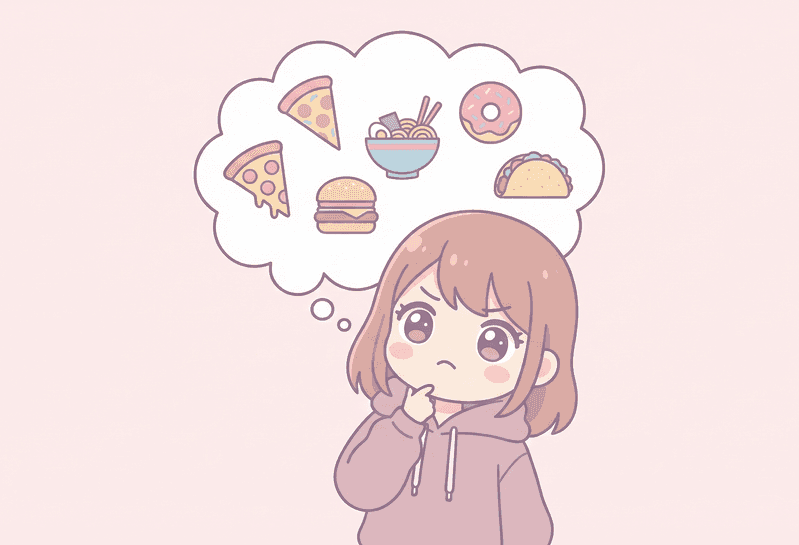
How Many Times Do You Ask "What Should I Eat?" Per Day?
Breakfast, lunch, dinner... you face "What should I eat?" at least three times a day. Add snacks and late-night munchies, and you're making food decisions five times or more daily. These small decisions add up, consuming a surprising amount of mental energy.
Psychologists call this "Decision Fatigue." The more decisions you make throughout the day, the lower the quality of your decisions becomes, eventually leading to a state where you can't decide anything at all. Food decision paralysis can be understood in this context.
Why Is Food Selection Particularly Difficult?
There are reasons why food choices feel harder than other decisions.
- Too many options: Opening a delivery app reveals thousands of menu items
- Daily repetition: You buy clothes or furniture once, but food is every day
- Emotion-driven: Your mood, weather, and energy levels change what you crave
- High regret potential: A bad choice means a ruined meal
- Considering others: You often need to accommodate others' preferences too
Tip #1: Pre-Narrow Your Options
Core Strategy
Don't decide when hungry—set up your options in advance.
When you're hungry, your brain's judgment becomes impaired. That's why choosing a menu when hungry feels harder and takes longer. The solution is simple: decide when you're full.
How to Practice:
- On Sunday, pre-plan 5 lunch options for the week
- Set 3 "default" restaurants you can always rely on
- Bookmark about 10 favorite items in your delivery apps
Tip #2: Create Daily Themes
Core Strategy
When you create rules, decisions become unnecessary.
Many successful people wear the same type of clothes every day. Similarly, creating food rules reduces decision burden.
Example Schedule:
- Monday: Korean (warm soup to beat Monday blues)
- Tuesday: Noodles (ramen, pasta, or noodle soup)
- Wednesday: Healthy (salad, poke bowl, grilled chicken)
- Thursday: Asian (Vietnamese, Thai, Japanese)
- Friday: Free choice (weekend vibes, eat what you want)
With themes set, your question becomes "Which Korean dish today?" instead of the overwhelming "What should I eat?"—much easier to answer.
Tip #3: The 2-Minute Rule
Core Strategy
Time limits speed up decisions.
According to Parkinson's Law, work expands to fill the time available. Give yourself 30 minutes to pick a menu, and you'll deliberate for 30 minutes. Give yourself 2 minutes, and you'll decide in 2 minutes.
How to Practice:
- Set a 2-minute timer and make your decision
- When time's up, pick the first thing that caught your eye
- Aim for "good enough" rather than "perfect"
The key insight is that most food choices don't have a "wrong" answer. Whether you have kimchi stew or soybean paste stew, you'll satisfy your hunger.
Tip #4: Use Random Selection Tools
Core Strategy
Outsourcing decisions reduces stress.
If decision-making itself is stressful, let something else decide for you. Try flipping a coin, rolling dice, or using a food recommendation app.
Here's an interesting insight: when a random result comes up and you think "No, not that one..."—that reaction tells you what you actually want. Use that feedback to make your final decision.
What to Eat's games (Random Pick, Food World Cup, Balance Game) are designed exactly for this purpose. Making decisions fun reduces stress.
Tip #5: Embrace "Satisficing"
Core Strategy
Aim for "good enough" instead of "the best."
Psychologist Barry Schwartz divides people into two types: "Maximizers" always seek the absolute best choice, while "Satisficers" are content with good enough.
Research shows satisficers are happier. Maximizers often regret their choices, wondering "Was there a better option?" even after deciding.
Satisficing Mindset:
- When you think "This seems tasty enough," decide immediately
- After choosing, don't think about other options
- Even if today's meal isn't perfect, you can always try again tomorrow
Bonus: Deciding When Eating With Others
If solo decisions are hard, group decisions are even more complex. Try these approaches:
- Veto Method: Each person names one thing they don't want, choose from the rest
- Take Turns: Person A decides this time, Person B decides next time
- 3-2-1 Method: One person suggests 3, the other narrows to 2, first person picks 1
- Use an App: Play What to Eat's Food World Cup together
Conclusion: Decision-Making Gets Easier With Practice
Food decision fatigue isn't a disease to cure—it's a habit to manage. Try applying these tips one by one and find what works best for you.
The most important thing is not to spend too much energy on food decisions. Save that energy for more important choices in your life. And for today's lunch? Just go with whatever catches your eye first. It'll be delicious, we promise.